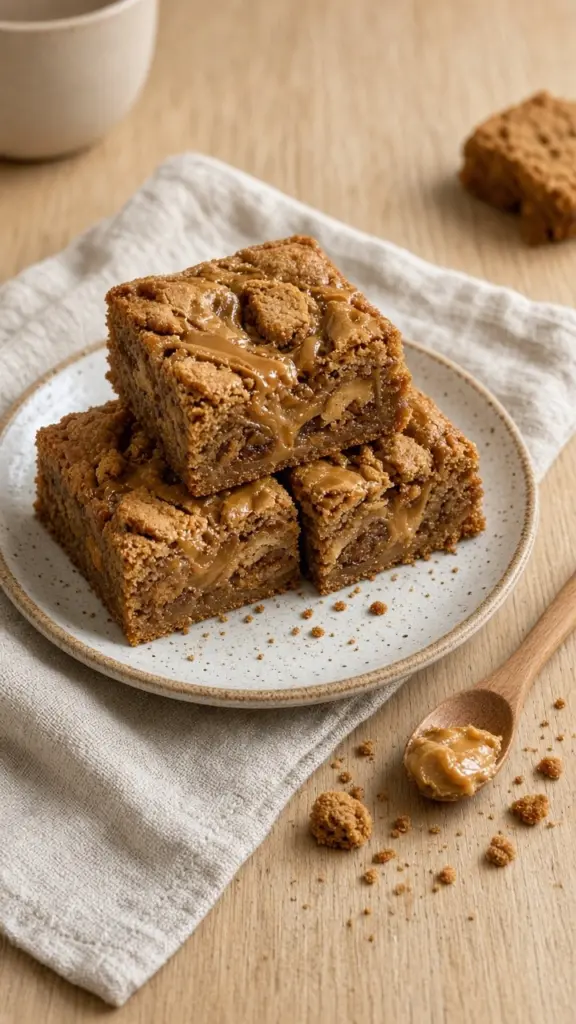
I made these Brown Butter Biscoff Blondies on a rainy Sunday when I wanted something sweet but could not face a complicated layer cake. The butter browned, the kitchen smelled like toasted caramel, and somehow half the blondies disappeared before they had properly cooled. Suspicious? Yes. Regrets? Not even slightly.
Why you will love these
I make these when ordinary brownies feel a bit too chocolatey and a plain cookie seems like it needs a little help. The brown butter gives the blondies a nutty, almost toffee like flavour, while the Biscoff spread keeps the middle soft and pleasantly chewy. My family goes a bit bonkers for them, especially when the edges are crisp but the centre still looks just a touch underdone.
And that swirl of cookie butter on top? It is not strictly necessary, but honestly, why would we behave ourselves?
What you will need
- 170g unsalted butter
- 200g light brown sugar
- 100g granulated sugar
- 2 large eggs, at room temperature
- 2 teaspoons vanilla extract
- 190g plain flour
- 1 teaspoon baking powder
- 1/2 teaspoon fine salt
- 120g Biscoff spread, divided
- 100g Biscoff cookies, roughly chopped
I usually use smooth Biscoff spread, though crunchy works too if you like little bits hiding in the blondies. Plain flour is what I use here; if you are in the UK, that is all purpose flour in some recipes. My grandmother always insisted on one particular butter brand, but honestly, any decent unsalted butter will do the job.
Equipment, without making a production of it
You will need a light coloured saucepan, a mixing bowl, a whisk, a spatula, and a 20cm square baking tin lined with baking paper. The light saucepan helps you see when the butter turns golden. If yours is dark, just trust your nose and keep a close eye on it. A wooden spoon works perfectly well if you do not have a spatula, although I think a spatula gets every last sticky bit from the bowl.
Let us bake some blondies
- Heat the oven to 180C, or 160C fan, and line a 20cm square baking tin with baking paper, leaving a little overhang on two sides.
- Melt the unsalted butter in a light coloured saucepan over medium heat, then keep cooking it until the milk solids turn golden brown and it smells nutty. Swirl the pan now and then; this usually takes 5 to 7 minutes.
- Pour the browned butter into a large mixing bowl and leave it for about 10 minutes so it is warm rather than piping hot.
- Whisk in the light brown sugar and granulated sugar until the mixture looks glossy and slightly thickened.
- Whisk in the eggs, one at a time, then add the vanilla extract. This is where I usually sneak a tiny taste, purely for quality control of course.
- Add the plain flour, baking powder, and salt, then fold everything together with a spatula until no dry streaks remain. Do not worry if it looks a bit weird at this stage; it always does.
- Fold in 80g of the Biscoff spread and the chopped Biscoff cookies, stopping as soon as they are spread through the batter.
- Scrape the batter into the prepared tin and gently smooth the top.
- Warm the remaining 40g of Biscoff spread for a few seconds in the microwave, then dot it over the batter and swirl it with the tip of a knife.
- Bake for 28 to 33 minutes, until the edges are golden and set but the centre still has a slight wobble.
- Cool the blondies completely in the tin before lifting them out and cutting them into squares.
A few notes from my slightly messy kitchen
Do not panic if the butter foams dramatically while it browns. Mine does this every time and I still watch it like it has personally betrayed me. The important bit is the little brown flecks at the bottom of the pan.
I think these taste better the next day, when the flavour settles and the middle gets even chewier. That said, warm one for 10 seconds and it becomes wonderfully soft again. Also, cut them with a sharp knife once they are cool. My first batch was cut warm and looked less like neat squares and more like a delicious landslide.
Variations I have tried
- Stir in 75g of white chocolate chips for a sweeter, creamier version.
- Add a generous pinch of flaky salt on top before baking. This is probably my favourite little upgrade.
- Swap half the Biscoff cookies for chopped toasted pecans if you want extra crunch.
- I tried adding banana once, thinking it would be cosy and clever. It made the blondies oddly cakey, so that experiment did not make the family recipe book.
How to store them
Keep the cooled blondies in an airtight container at room temperature for up to 4 days. You can refrigerate them too, but they firm up quite a bit, so let them sit out before eating. They freeze well when wrapped individually. Though honestly, in my house they never last more than a day.
How I like to serve them
My preferred way is slightly warm, with a scoop of vanilla ice cream and a very small drizzle of extra Biscoff spread. For a less dramatic moment, they are lovely with a cup of tea. My sister insists on eating hers straight from the fridge, which I maintain is strange but completely acceptable.
Pro tips learned the hard way
- Let the browned butter cool before adding the eggs. I once tried rushing this step and regretted it because the mixture became lumpy and far too warm.
- Do not overbake the blondies. They continue cooking as they cool, and a skewer should have a few moist crumbs rather than coming out bone dry.
- Line the tin properly. It sounds dull, but lifting the whole slab out is much easier than wrestling sticky corners with a butter knife.
- Actually, I find it works better if the eggs are at room temperature, but I have also made these with cold eggs and nobody complained.
Questions people have asked me
Can I use salted butter?
Yes, you can. Just reduce the added salt a little, or leave it out if your butter is especially salty. The recipe is forgiving.
Why did my blondies turn out cakey?
Usually they have been baked a little too long, or the flour was packed into the measuring cup. Spoon the flour into the cup and level it, or weigh it for better results.
Can I make these without Biscoff cookies?
Absolutely. They will still be lovely with just the spread, though you will lose some of that fun little crunch. Digestive biscuits can work in a pinch too.
Can I brown the butter ahead of time?
Yes, and it is a handy shortcut. Let it cool, cover it, and keep it in the fridge for up to 3 days. Bring it back to a soft or liquid state before mixing.
How do I know when they are done?
The edges should look set and lightly golden, while the centre should wobble just a little when you nudge the tin. If it sloshes, give it another few minutes; if it is completely firm, you may have gone a touch too far.